













- IoT-based smart water metering replaces manual meter reading with automatic, real-time data transmission — enabling accurate billing, instant leak alerts, and remote valve control across entire distribution networks.
- The system architecture spans smart meters, flow and pressure sensors, LPWAN communication modules (LoRa, NB-IoT), cloud platforms like Azure IoT Hub, and AI/ML analytics layers for anomaly detection and demand forecasting.
- Real-time consumption monitoring gives utilities and consumers granular visibility into usage patterns, helping cities reduce peak-time consumption and identify hidden leaks before significant water is lost.
- Predictive maintenance powered by Azure Machine Learning enables utilities to forecast meter or pipe failures days in advance, reducing technician dispatches and costly reactive repairs.
- Future directions include edge computing for on-device analytics, AI-driven personalized conservation tips, blockchain-based billing transparency, and 5G-enabled meters for ultra-fast, reliable data transmission.
Smart water metering is helping utilities improve how they monitor consumption, detect leaks, manage distribution networks, and deliver more accurate usage information. By combining smart meters, IoT connectivity, sensors, cloud platforms, and analytics, utilities can move from periodic manual readings toward more connected and data-driven water management.
From real-time consumption monitoring and leak detection to predictive maintenance and remote valve operation, IoT-enabled smart water metering can improve operational visibility while supporting water conservation and more efficient utility management.
In this article, we explore how IoT is transforming smart water metering, the key applications for utilities, the technology components involved, implementation challenges, and emerging trends in connected water management.
What Is Smart Water Metering?
Smart water metering uses connected meters and digital technologies to automatically capture and transmit water consumption information.
Unlike traditional meters that typically require manual readings, smart meters can provide utilities with more frequent consumption data and enable remote monitoring.
An IoT-enabled smart water metering environment can include:
- Smart water meters
- Flow and pressure sensors
- Communication modules
- Gateway devices
- Cloud platforms
- Data analytics
- Utility dashboards
- Customer applications
The collected information can help utilities understand consumption patterns, identify unusual activity, support leak detection, improve billing processes, and make better operational decisions.
Traditional vs. Smart Water Meters: A Quick Comparison
| Feature | Traditional Meters | Smart IoT-Enabled Meters |
| Reading Method | Manual | Automatic (Remote) |
| Data Frequency | Monthly/Quarterly | Real-time |
| Leak Detection | Not available | Immediate alerts |
| Maintenance | Reactive | Predictive |
| Billing Accuracy | Prone to estimation | Highly accurate |
| Integration | Standalone | Integrated with cloud analytics |
Core Components of an IoT Smart Water Metering System
A connected water metering system typically combines several technology layers.
Smart Meters
Smart meters digitally record water consumption and transmit usage information for processing.
Sensors
Flow, pressure, tamper, and other sensors can provide additional information about network and meter conditions.
Communication Layer
Connectivity technologies such as NB-IoT, LoRaWAN, cellular networks, or RF can transmit meter data, depending on the deployment environment.
Gateways
Gateway devices can aggregate information from connected devices and transmit it to backend systems.
Cloud and Data Platforms
Cloud platforms provide environments for storing, processing, integrating, and managing connected-device data.
Analytics
Analytics can help identify consumption patterns, anomalies, potential leaks, and other operational conditions.
Dashboards and Applications
Utility teams and consumers can access relevant information through dashboards, portals, or applications.
6 Key Applications of IoT in Smart Water Metering
1. Real-Time Consumption Monitoring
Connected meters can provide utilities with more frequent visibility into water consumption. Instead of relying only on periodic readings, utilities can analyze usage patterns across individual meters, zones, or distribution areas.
This can help identify unusual consumption, understand demand patterns, and support more informed water-management decisions. For consumers, access to usage information can also make it easier to understand consumption and identify potential problems.
2. Leak Detection and Alerts
Leaks can result in significant water loss and can be difficult to identify through periodic meter readings alone. IoT-enabled meters and sensors can help identify unusual consumption patterns, flow behavior, or pressure changes that may indicate a potential leak.
A connected workflow could look like:
Meter Data → Anomaly Detection → Potential Leak Identified → Alert → Investigation
Utilities can use these alerts to prioritize investigation, while customers can be notified when unusual consumption is detected.
3. Automated Billing and Revenue Accuracy
Manual readings and estimated consumption can create challenges for utilities and customers. Smart meters can automatically transmit recorded consumption data to connected utility systems, reducing the need for manual meter collection.
This can support:
- More accurate usage records
- Reduced manual data collection
- Faster access to consumption information
- Improved billing processes
- Greater visibility for customers
Smart metering can therefore become part of a broader digital utility environment rather than operating as an isolated meter-reading system.
4. Predictive Maintenance
Connected meter and infrastructure data can provide useful signals about equipment and network conditions.
When historical and real-time information is analyzed, utilities can identify patterns that may indicate potential equipment problems.
This can support a more proactive maintenance approach for meters, valves, pumps, and other relevant infrastructure.
The objective is to help maintenance teams prioritize assets that require investigation rather than relying exclusively on fixed maintenance schedules.
5. Pressure and Flow Monitoring
Pressure and flow monitoring can provide utilities with greater visibility into water distribution networks.
Connected sensors can help identify abnormal pressure or flow conditions across different zones.
This information can support investigation of:
- Potential leaks
- Pressure abnormalities
- Distribution issues
- Equipment conditions
- Changes in network demand
Combining meter information with broader network data can give utility teams a more complete view of water operations.
6. Remote Valve and Infrastructure Management
Connected water infrastructure can support remote monitoring and, where the system is designed for it, remote control of selected equipment. For example, utilities may use connected valve systems to support maintenance activities or respond to specific operational situations.
Any automated control should be implemented with appropriate operational safeguards, access controls, and human oversight based on the utility’s requirements.
Benefits of Smart Water Metering for Utilities
Reduced Manual Work
Remote meter data collection can reduce dependence on manual readings and field visits.
Improved Leak Detection
More frequent data can help utilities identify unusual consumption or network conditions sooner.
Better Water Conservation
Improved visibility into consumption and losses can support more informed conservation initiatives.
More Accurate Billing
Recorded consumption data can reduce reliance on estimated readings.
Better Demand Visibility
Utilities can analyze consumption patterns across customers, zones, and networks.
Proactive Asset Management
Connected data can support condition monitoring and maintenance prioritization.
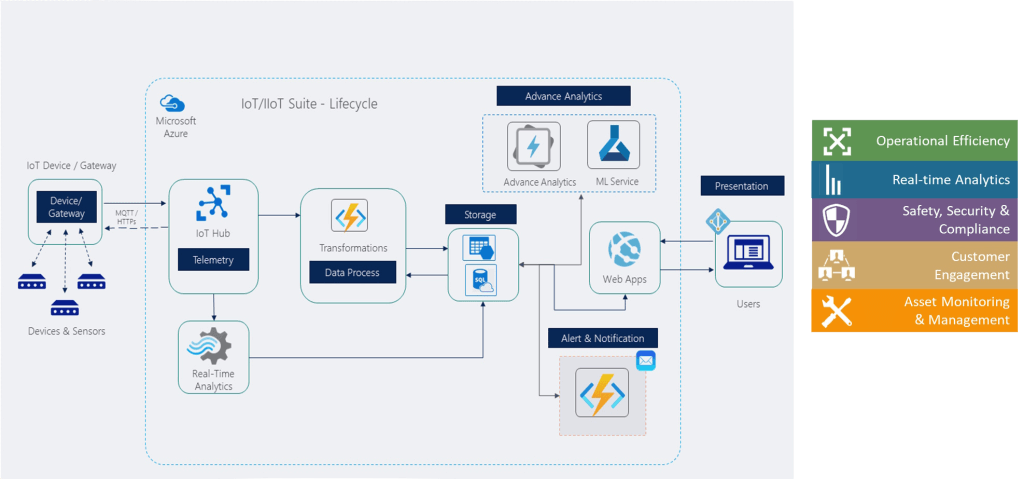
Azure IoT for Smart Water Metering
Cloud and IoT platforms can provide the infrastructure needed to manage connected water devices and process the data they generate. Microsoft Azure provides IoT and cloud capabilities that can support connected-device environments.
Depending on the architecture, an Azure-based solution can incorporate capabilities for:
- Device connectivity and management
- Real-time data processing
- Data storage and integration
- Analytics
- Digital models
- Business intelligence and dashboards
A typical architecture could be represented as:
Smart Meters & Sensors → Connectivity → IoT Platform → Data & Analytics → Utility Applications
The exact Azure services and architecture should be selected based on the utility’s device environment, data requirements, security needs, and existing systems.
Security and Compliance Considerations
Water infrastructure is an important part of critical infrastructure, making cybersecurity an essential consideration for connected metering environments.
Key areas include:
Data Protection
Data should be protected while being transmitted between devices, networks, and backend systems.
Device Authentication
Connected devices need appropriate authentication and access controls.
Secure Updates
Device firmware and software should be maintained through controlled and secure update processes.
Access Management
Utilities should restrict access to connected devices, applications, and operational systems according to defined roles and requirements.
Regulatory Requirements
The relevant privacy, cybersecurity, and water-sector requirements should be assessed based on the geography and deployment environment.
Challenges in Implementing Smart Water Metering
Initial Deployment Costs
Replacing existing meters and deploying communication infrastructure can require significant upfront investment.
Connectivity
Remote locations and underground infrastructure can create connectivity challenges depending on the technology and deployment environment.
Data Management
Large-scale deployments can generate substantial volumes of meter and sensor data that require appropriate storage, processing, and analytics infrastructure.
Legacy Integration
Utilities may need to integrate smart metering with existing billing, customer information, asset management, GIS, and operational systems.
Organizational Adoption
Utility teams and customers may require training and change management when moving from traditional metering processes to connected systems.
Challenges in Implementing IoT Water Metering Systems
 Initial Cost of Deployment: Smart meters and infrastructure setup can be expensive upfront.
Connectivity Issues: Remote rural areas may face network reliability issues.
Data Overload: Managing terabytes of sensor data requires robust backend architecture.
Resistance to Change: Consumers and utility workers need training and awareness.
Initial Cost of Deployment: Smart meters and infrastructure setup can be expensive upfront.
Connectivity Issues: Remote rural areas may face network reliability issues.
Data Overload: Managing terabytes of sensor data requires robust backend architecture.
Resistance to Change: Consumers and utility workers need training and awareness.Future Trends in Smart Water Metering
The smart water metering landscape is continuing to evolve as IoT becomes more closely connected with analytics, AI, and automation.
Edge Computing
Processing selected information closer to connected devices can support faster responses and reduce the need to transmit every data point to centralized systems.
AI-Driven Water Management
AI can help identify consumption patterns, anomalies, potential leaks, and other operational conditions from large volumes of water data.
Digital Twins
Digital twins can provide digital representations of assets or distribution networks to support monitoring, analysis, and scenario planning.
Advanced Connectivity
New connectivity technologies can provide additional options for connecting distributed meters and water infrastructure.
Intelligent Utility Operations
The combination of IoT, analytics, AI, and connected workflows can help utilities move from simply monitoring water consumption toward more proactive operational management.
Building Smarter Water Operations with IoT
Smart water metering is more than a replacement for traditional meter reading. When connected with IoT, cloud platforms, analytics, and utility systems, smart meters can become part of a broader digital infrastructure for water management.
From consumption monitoring and leak detection to predictive maintenance and network visibility, connected metering can help utilities make better use of operational data.
The long-term opportunity is to connect meters, infrastructure, data, analytics, and operational workflows so utilities can respond more proactively to changing conditions while improving efficiency and water management.