





































Enterprise intelligence once meant data warehouses, dashboards, and analytics teams answering business questions.
Today, enterprise AI is changing how organizations collect, interpret, and act on information.The shift is from reporting what happened to enabling faster, more informed decisions.
Key takeaways
- Enterprise AI moves intelligence from reporting toward continuous decision-making.
- AI can improve speed, accuracy, and operational efficiency across business functions.
- Data quality, governance, and integration remain critical to successful AI adoption.
- Moving from AI pilots to production requires monitoring, infrastructure, and organizational readiness.
- The strongest AI strategies focus on business outcomes, not just technology.
From Reporting to Intelligent Decision-Making
Traditional business intelligence was largely backward-looking. Organizations could see what happened, identify trends, and use those insights to plan the next step.
Enterprise AI changes this flow. Intelligent systems can identify patterns, generate recommendations, and trigger actions within defined boundaries. The human role shifts from processing information to setting objectives, defining boundaries, and reviewing outcomes. This creates a more continuous approach to enterprise intelligence, where data can support decisions as business conditions change.
How Enterprise AI Is Changing Intelligence Across the Business
AI in data analytics is influencing multiple areas of the enterprise.
Operations
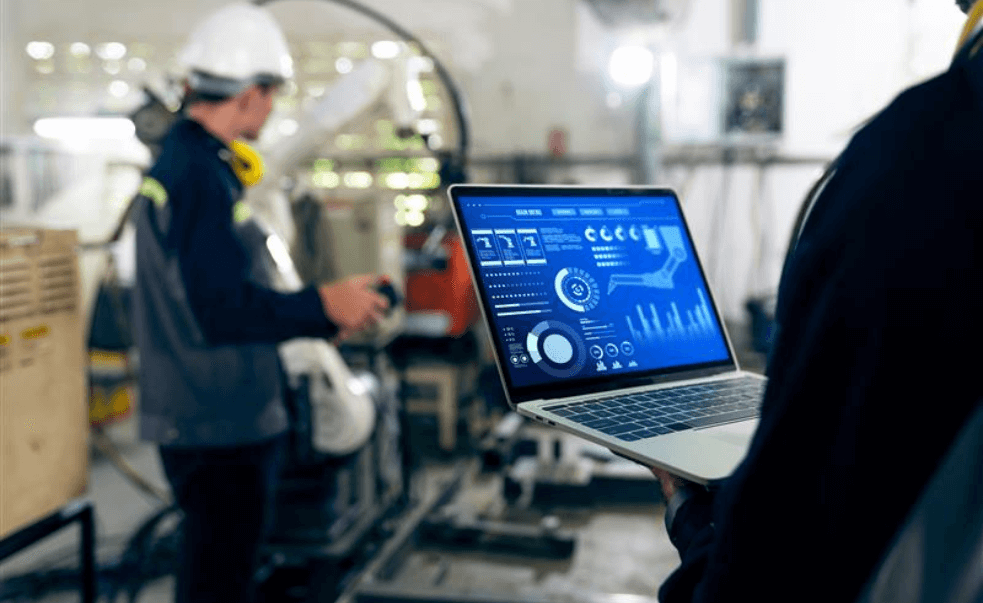
- AI enables real-time monitoring, anomaly detection, and predictive insights that can identify equipment issues, process deviations, and supply chain risks earlier.
Finance
- AI can accelerate forecasting and scenario planning by combining historical data with additional business and market signals.
Customer experience
- AI enables more personalized recommendations, pricing, communication, and service based on individual customer behavior and context.
Real-World Business Outcomes
The value of enterprise AI can be seen across three key areas:
Industries Driving Enterprise AI Adoption
| Industry | Primary AI use case | Business outcome |
|---|---|---|
| Manufacturing | Predictive maintenance, quality control | Lower downtime and defects |
| Financial Services | Fraud detection, risk scoring | Faster decisions, reduced losses |
| Retail & Ecommerce | Forecasting, personalization | Higher conversion, lower overstock |
| Energy & Utilities | Grid optimization, forecasting | Improved efficiency |
| Healthcare | Diagnostic support, risk prediction | Earlier intervention |
| Supply Chain | Disruption prediction, route optimization | Greater resilience |
These applications show that enterprise AI is not limited to a single business function. Its value increases when intelligence connects data, decisions, and workflows across the organization.
Challenges Enterprises Face in Adopting AI
- Data readinessAI systems depend on reliable, accessible data. Poor data quality, fragmented systems, and inconsistent definitions can limit the performance of AI initiatives. Strong data governance and data integration are therefore foundational.
- Organizational readinessAI changes how work gets done. Clear communication about AI’s role, human responsibilities, and decision boundaries is essential for building trust and adoption.
- Moving from pilots to productionA model that performs well in a controlled environment may behave differently with real production data and changing conditions. Continuous monitoring, retraining, and governance are necessary to maintain performance.
What an AI-Driven Enterprise Looks Like
Organizations successfully scaling enterprise AI tend to share three characteristics:
that can be accessed across teams
defining where systems can act autonomously and where humans remain involved
focused on measurable outcomes rather than technology milestones
AI literacy also needs to extend beyond technical teams. When business leaders understand AI’s capabilities and limitations, they can make better decisions about where it should be applied For organizations exploring more autonomous AI systems, the Agentic AI Checklist for Enterprise Leaders can help assess broader readiness.
Why Acting Now Matters
Enterprise AI is becoming an important part of how organizations compete. But successful adoption does not begin with choosing an AI platform. It begins with building the foundations that AI depends on. Prioritize data quality, governance, integration, and production readiness before scaling AI use cases.
Enterprise AI is not about replacing human judgment. It is about giving people better information, faster, so they can make more informed and consistent decisions.
Move from AI Strategy to Production
Infysion helps enterprises build the data, AI, and technology foundations needed to move from experimentation to production.
Build smarter enterprise intelligence with AI.FAQs
What is enterprise intelligence?
Enterprise intelligence is the ability to use organizational data, analytics, and AI to support better business decisions and operations.
How does AI transform enterprise intelligence?
AI moves intelligence beyond static reporting by identifying patterns, generating recommendations, and supporting or automating decisions within defined boundaries.
What is the biggest challenge in enterprise AI adoption?
Data readiness is one of the most important challenges. Poor data quality, fragmented systems, and weak governance can limit AI performance.
How can enterprises start their AI journey?
Start by identifying high-value business problems, assessing data readiness, strengthening governance, and building production capabilities before scaling AI across the organization.